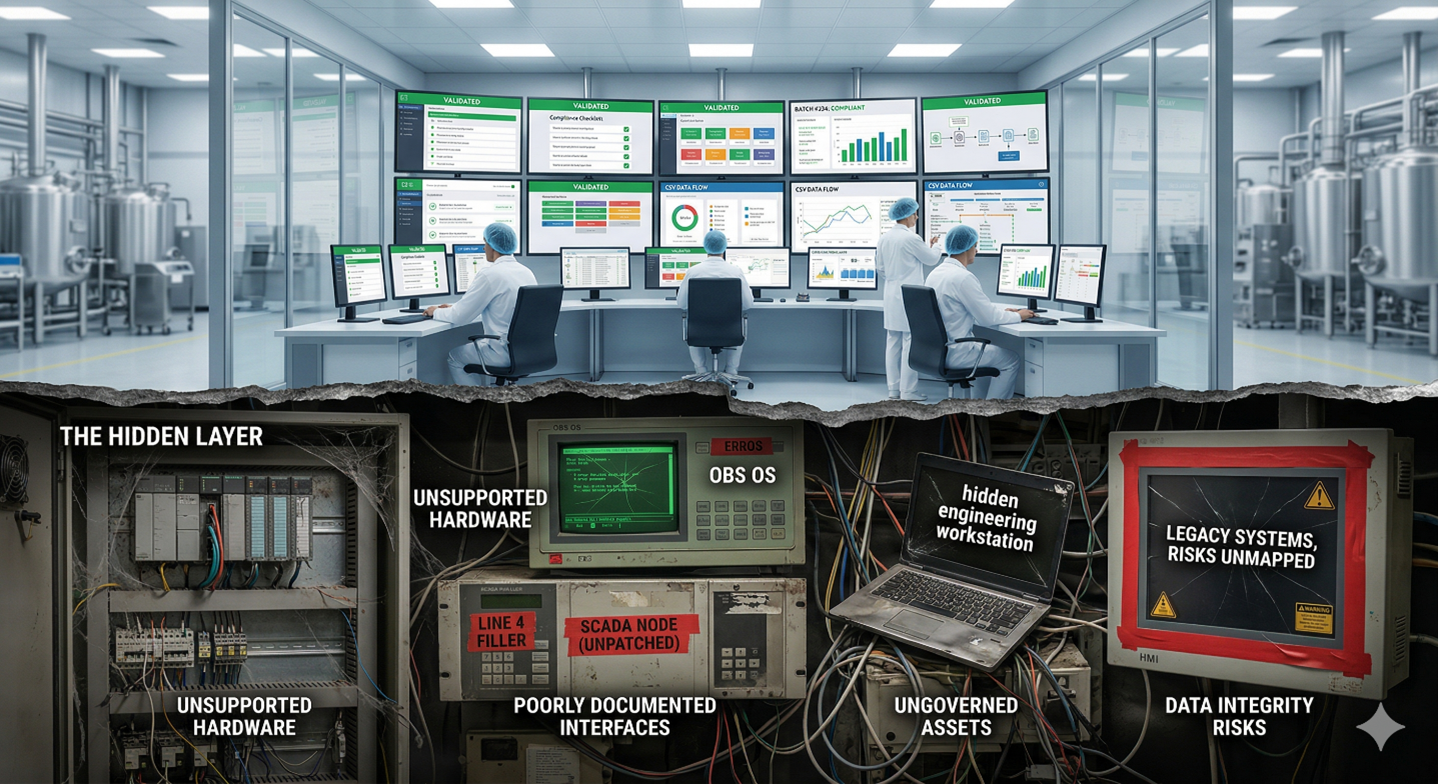
Many pharmaceutical companies have good visibility of business IT systems and formal validated applications, but much less visibility of the operational technology (OT) layer underneath them. Often, organisations rely on automation components that are no longer supported. As support fades, the risk of breakdowns, delays, and security gaps, grows.
Vendor Support has Ended
Your manufacturing operations may be running on automation hardware and software components (‘OT layer’), which are outdated and / or unsupported by the supplier.
This OT layer includes the control systems and supporting devices that directly run manufacturing equipment, utilities and environmental controls. It can include PLCs, HMIs, SCADA, engineering and other PC workstations, EMS/BMS components and network devices.
In many sites, these assets have accumulated over time across different projects, equipment purchases, utilities’ installations and other upgrades. As a result, the OT layer may be only partially documented, unevenly governed and not fully represented in validation, periodic review or asset management processes.
Regulatory Risks
- If you have not audited your OT layer, you may not have met your PIC/S Annex 11 requirement to perform periodic reviews.
- You may also not be meeting PIC/S Annex 11 requirements around lifecycle management, security, and business continuity.
Operational Risks
- Obsolete automation hardware is harder to source, so production operations may be impacted.
- No support from vendor when technical issues arise.
- Failure rates increase as control hardware ages.
- Legacy platforms provide limited diagnostics and fault visibility
Vulnerabilities
Obsolete Hardware is vulnerable to Cyberattack.
Typical Site Challenges
- The OT layer is known in fragments rather than as a complete picture.
- Engineering, IT, production and QA, each hold part of the knowledge.
- Assets are not consistently documented at the asset level.
- Remediation needs are difficult to prioritise without a structured baseline.
In this situation, decision-making is often slowed by uncertainty.
Basically, you don't know what you don't know.
Why an OT Layer Audit is Needed
An OT layer audit provides a structured way to establish the current-state at the site.
It helps the site to:
- Identify OT assets and systems relevant to GMP operations.
- Organise a practical asset list across production, utilities, EMS, BMS, HVAC and other related areas.
- Understand which assets are legacy, unsupported, end-of-life or otherwise difficult to sustain.
- Map key data paths and interfaces into validated or business systems.
- Review where governance boundaries are unclear across engineering, IT, production and QA.
- Convert technical observations into a form that supports quality risk management and planning.
The purpose of the audit is to help the company understand how hidden OT-layer conditions may affect validated state, data integrity, operational resilience and future compliance expectations.
How Does it Work?
- Our technical representatives will visit your site for an initial consultation (free of charge).
- Our experts in your particular automation equipment, will perform an onsite OT layer audit*.
- A detailed report* is written by the auditor(s) and issued to you, the client.
*The audit and report are completed at a single fixed price
A Planned Path Forward
- By addressing obsolescence early, asset owners can reduce risk, improve budget certainty, and schedule upgrades around production requirements.
- Work together to define a risk-based, validated hardware and software migration roadmap, prioritising your highest-consequence OT component first.
Intended Outcome
The intended outcome is a clearer understanding of the OT layer that sits beneath pharmaceutical operations, and a practical basis for deciding what must be addressed now, what can be risk-managed temporarily, and what should be planned as part of a longer-term remediation or modernization program.
How a MESCADA / SeerPharma Team Can Help
- Proven experience upgrading legacy systems.
- Structured migration approach.
- Fully validated solution.
- Planned delivery aligned to operational requirements.
- Greatly experienced working in regulated industries.
Contact us to discuss your needs and how we can help.
Learn more about SeerPharma's Computerised System Validation Consulting